
Type Ia Supernovae#
The SNeIa class is the built-in, ready-to-use transient for Type Ia Supernovae. A tutorial of how to use them is already in the “Transient” documentation. Here we show the default settings of this class.
The SNeIa Transient is already defined and ready to use:
import skysurvey

snia = skysurvey.SNeIa()
Template#
The default template is the SALT2 template, used to model the spectral evolution of the SNeIa.
snia.template
<skysurvey.template.Template at 0x1389109b0>
You can access the corresponding sncosmo source directly:
snia.template.source
<SALT2Source 'salt2' version='T23' at 0x138913ad0>
And its parameters names:
['z', 't0', 'x0', 'x1', 'c', 'mwebv', 'mwr_v']
['z', 't0', 'x0', 'x1', 'c', 'mwebv', 'mwr_v']
Rate#
Each pre-computed skysurvey transient has a default volumetric rate, that provide the number of transient expected per year and per Gpc³. The SNeIa rate is derived from Perley et al.(2020) (2020ApJ…904…35P).
snia.rate
23500.0
Model#
The model is based on the modeldag package.
For the SNeIa class, the model contains 8 entries. So the generated data will contains at least 8 columns. To display the model, you can directly print the object:
snia
{'redshift': {'func': 'draw_redshift',
              'kwargs': {'zmax': 0.2, 'rate': 23500.0},
              'as': 'z'},
 'x1': {'func': <function SNeIaStretch.nicolas2021 at 0x1388ff7e0>,
        'kwargs': {}},
 'c': {'func': <function SNeIaColor.intrinsic_and_dust at 0x1388ff740>,
       'kwargs': {}},
 't0': {'func': <bound method Generator.uniform of Generator(PCG64) at 0x13890D620>,
        'kwargs': {'low': 56000, 'high': 56200}},
 'magabs': {'func': <function SNeIaMagnitude.tripp1998 at 0x1388ff880>,
            'kwargs': {'x1': '@x1', 'c': '@c', 'mabs': -19.3, 'sigmaint': 0.1}},
 'magobs': {'func': 'magabs_to_magobs',
            'kwargs': {'z': '@z', 'magabs': '@magabs'}},
 'x0': {'func': 'magobs_to_amplitude',
        'kwargs': {'magobs': '@magobs', 'param_name': 'x0'}},
 'radec': {'func': <function random_radec at 0x138825e40>,
           'kwargs': {},
           'as': ['ra', 'dec']}}
Printing the model also show the color distribution, the stretch distribution and the absolute magnitude distribution by default.
Color distribution#
In skysurvey, the color distribution is implemented through the class SNeIaColor. This class provides several possible functions to model the observed color distribution of the SNeIa, and has a default color distribution.
Default color distribution#
The default color distribution is the SNeIaColor.intrinsic_and_dust()function, following Ginolin et al. (2025) (2025A&A…695A.140G). It combines a Gaussian distribution, that represents the intrinsic SN Ia color scatter, convoluted with an exponential decay, accounting for additional reddening due to the interstellar dust of the host galaxy such that:
The default parameters are:
c_int= −0.075σ_int= 0.05τ= 0.14
Let’s see a simple visualization of the shape of the probability density function (PDF):
import matplotlib.pyplot as plt
from skysurvey.target.snia import SNeIaColor

xx, pdf = SNeIaColor.intrinsic_and_dust()
fig = plt.figure(figsize=[6,4])
plt.plot(xx, pdf, color="darkred")
plt.xlabel("c")
plt.ylabel("PDF")
plt.show()
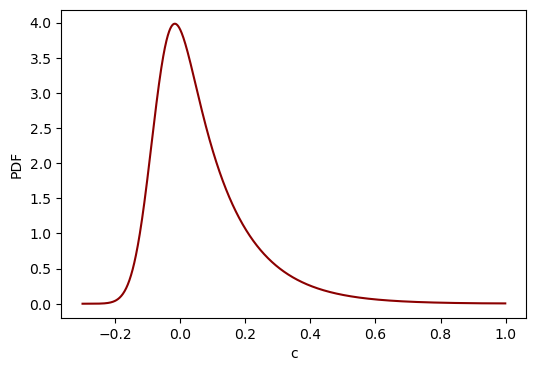
Stretch distribution#
The stretch distribution SNIaStretch.nicolas2021() is implemented through the class SNeIaStretch, and is modeled using the two-component Gaussian model from Nicolas et al.(2021) (2021A&A…649A..74N),
which captures the mix of “prompt” and “delayed” SN Ia populations.
This model mixes two normal distributions:
where:
The first mode \((\mu_1, \sigma_1)\) describes the prompt SNe Ia
The second mode \((\mu_2, \sigma_2)\) describes the delayed SNe Ia
The
aparameter is the relative influence of both modes (1 or 2) in the delayed environment.a>0.5means more mode 1.The
f_promptparameter is the fraction of prompt SNe Ia
The default parameter are:
μ_1= 0.33σ_1= 0.64μ_2= −1.50σ_2= 0.58a= 0.45f_prompt= 0.5
Optionally, the parameter f_prompt can depend on redshift, but if no redshift is passed, f_prompt = 0.5 is used as a constant default.
Absolute magnitude#
The default absolute magnitude distribution SNeIaMagnitude.tripp1998() is computed following the Tripp et al.(1998) (1998A&A…331..815T) relation, with the following default parameters:
mabs(average absolute magnitude)= -19.3σ_int= 0.10α= -0.14β= 3.15
You can also include host-mass corrections with the alternative absolute magnitude distribution that includes the mass step:
from skysurvey.target.snia import SNeIaMagnitude
SNeIaMagnitude.tripp_and_massstep(x1, c, hostmass)
For which the default parameters are:
mabs= -19.3,σ_int= 0.10α= -0.14β= 3.15γ(step’s amplitude) = 0.1split(host mass boundary between low-mass and high-mass hosts) = 10